






Sustainable Laboratory Workflows Through Precision Liquid Handling
10/09/2026
Share this blog
10/09/2026


Laboratories are under increasing pressure to improve sustainability while accelerating scientific discovery. Advances such as precision liquid handling, assay miniaturization and improved experimental design can reduce reagent consumption, minimize plastic use and enhance workflow efficiency without compromising data quality. This review examines how sustainable laboratory practices can be achieved through optimized experimental strategies rather than focusing solely on consumable reduction.
The role of Design of Experiments (DoE), reaction miniaturization and automated liquid handling is discussed in the context of reducing experimental waste and improving reproducibility across applications including genomics, assay development and cell-based research. Low-volume dispensing technologies enable accurate and consistent liquid handling at nanoliter to microliter scales, supporting efficient use of reagents and samples. Systems such as the dragonfly discovery and mosquito platforms (SPT Labtech) are presented as examples of how these approaches can be implemented in practice.
Overall, these methods demonstrate how laboratories can increase data output per sample while reducing environmental impact, highlighting the importance of experimental design and liquid handling strategies in advancing more sustainable laboratory science.
Sustainability has become an important consideration across life science research, as laboratories are increasingly expected to reduce their environmental impact while accelerating scientific discovery, improving reproducibility and operating within tighter financial constraints. Many laboratory workflows are inherently resource-intensive, relying on single-use plastics, energy-demanding equipment and large volumes of chemical and biological reagents. As a result, there is increasing interest in approaches that enable more efficient use of resources without compromising data quality or reproducibility.
Traditional sustainability efforts in laboratories have often focused on waste management, recycling and energy use. While these measures remain important, there is growing recognition that upstream factors, such as experimental design and workflow efficiency, also play a key role in determining overall environmental impact. Inefficient experimental setups, repeated optimization cycles and unnecessary reagent consumption can contribute significantly to both operational costs and laboratory waste.
Rather than viewing sustainability and experimental performance as competing priorities, advances in experimental design and liquid handling approaches demonstrate that both can be achieved through more efficient use of reagents, consumables and researcher time.
Building on these considerations, approaches such as assay miniaturization, precision liquid handling and Design of Experiments (DoE) provide opportunities to address these challenges. By reducing reaction volumes, improving experimental planning and increasing consistency in liquid handling, these methods can support more efficient use of materials and reduce variability between experiments. This can help decrease the need for repeat experiments while improving the reliability of results.
These strategies are increasingly applied across a range of research areas, including genomics, assay development, drug discovery and cell-based studies. Advances in liquid handling technologies have enabled more accurate low-volume dispensing and flexible workflow design, allowing researchers to generate more data from limited samples and reagents.
This review examines how these methodological approaches contribute to more sustainable laboratory practices. It brings together examples from different application areas to illustrate how improvements in experimental design and liquid handling can reduce resource consumption while supporting reproducibility and data quality.
In this context, non-contact dispensing and positive displacement pipetting represent two key liquid handling approaches used to improve accuracy and reproducibility in laboratory workflows. Non-contact systems, including those based on positive displacement syringe technology, enable rapid and flexible reagent distribution without direct contact between the dispensing head and the liquid, which can reduce dead volume and the risk of cross-contamination. In contrast, positive displacement pipetting uses a physical piston in direct contact with the liquid, allowing accurate handling of a wide range of liquid types, including viscous, volatile or low-surface-tension reagents. These characteristics make both approaches suitable for applications requiring precise and consistent liquid handling across varying volumes and reagent conditions.
These liquid handling approaches are applied across a range of laboratory workflows, including assay development, genomics, drug discovery and cell-based experiments. Non-contact dispensing systems are commonly used for tasks such as reagent distribution, generation of concentration gradients and multi-factorial assay setup for Design of Experiments (DoE). Positive displacement pipetting is typically applied in workflows requiring highly accurate low-volume transfers, including library preparation, serial dilution, normalization and sample transfer. The selection of a specific approach depends on the requirements of the workflow, including volume range, throughput and liquid properties.
In practice, these approaches are implemented through a range of liquid handling systems. Platforms such as dragonfly discovery and mosquito (SPT Labtech) apply non-contact dispensing and positive displacement pipetting in complementary ways, enabling different liquid handling strategies to be used across a range of laboratory workflows.
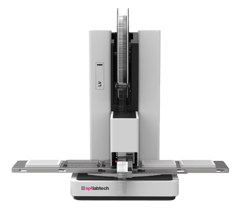 dragonfly discovery operates via non-contact dispensing based on positive displacement syringe technology and is used in workflows including assay development, Design of Experiments (DoE), drug discovery and cell-based assays. Features such as multi-channel dispensing and low dead-volume reservoirs support flexible reagent distribution and the setup of complex experimental designs while also reducing reagent use.
mosquito utilizes precisely engineered positive displacement pipetting tips to enable accurate handling of low-volume samples at the nanoliter scale. It is used in workflows such as genomics, library preparation, serial dilution and sample transfer, where precise and reproducible liquid handling is required.
Positive displacement pipetting outperforms traditional air displacement pipetting systems by increasing accuracy at low volumes and across a range of different liquid classes, resulting in a more streamlined experimental design.
Other liquid handling approaches, including acoustic dispensing and conventional air displacement pipetting systems, are also used in laboratory workflows, with selection depending on factors such as assay format, throughput requirements and reagent characteristics.
BlackFrame-1.png?width=250&height=290&name=dragonfly_front(st01)BlackFrame-1.png) Miniaturization has become one of the most effective strategies for improving laboratory sustainability. Reducing dispensing volumes from microliters to nanoliters decreases the consumption of reagents, biological samples, chemical compounds and single-use plastics. This reduction also lowers the environmental impact associated with the production, transport and disposal of laboratory consumables.
Miniaturization has become one of the most effective strategies for improving laboratory sustainability. Reducing dispensing volumes from microliters to nanoliters decreases the consumption of reagents, biological samples, chemical compounds and single-use plastics. This reduction also lowers the environmental impact associated with the production, transport and disposal of laboratory consumables.
Low-volume liquid handling enables more efficient use of materials while maintaining or increasing experimental throughput. In applications such as genomics, assay development and drug discovery, miniaturized workflows can enable higher-density assay formats and more extensive experimental designs without proportionally increasing resource consumption. This allows more experimental conditions to be evaluated within a given workflow, supporting increased data generation from reduced material inputs.
dragonfly discovery and mosquito (SPT Labtech) enable non-contact dispensing and positive displacement pipetting in miniaturized workflows. These systems support low-volume liquid handling across a range of applications, including nanoliter-scale transfers and multi-factorial assay setup, while maintaining reproducibility across applications.
Although they address different workflows, these liquid handling approaches support more efficient use of laboratory resources while enabling increased experimental output.
dragonfly discovery (SPT Labtech) supports assay development through flexible experimental design, including Design of Experiments (DoE), concentration gradients and independent reagent dispensing. These features allow multiple experimental variables to be evaluated within a single workflow, reducing optimization cycles and associated resource consumption.
mosquito (SPT Labtech) is used for accurate nanoliter-scale pipetting in applications including genomics, structural biology and drug discovery. By enabling reduced reaction volumes while maintaining precision and reproducibility, these approaches support lower reagent consumption and reduced plastic use without increasing experimental complexity.
Together, these complementary approaches contribute to more efficient laboratory workflows by reducing waste, conserving valuable samples and supporting reproducible experimental outcomes.
The impact of precision liquid handling on laboratory sustainability can be illustrated through application-focused examples. While different liquid handling approaches address distinct workflows, both non-contact dispensing and positive displacement pipetting can contribute to reduced resource consumption and improved experimental efficiency.
BlackFrame-1.png?width=250&height=268&name=dragonfly_low_perspective_no%20background(st1)BlackFrame-1.png) dragonfly discovery: experimental design and assay optimization
dragonfly discovery: experimental design and assay optimizationdragonfly discovery (SPT Labtech) is uniquely positioned to address workflows that combine assay miniaturization with flexible experimental design. Independent multi-channel dispensing enables the distribution of multiple reagents in parallel, supporting the evaluation of several experimental variables within a single assay setup. This reduces the number of optimization cycles required to establish robust assay conditions.
The use of low dead-volume reservoirs and accurate dispensing over a broad volume range allows efficient use of reagents and consumables. In this context, workflows can be designed to generate larger experimental datasets while reducing material consumption.
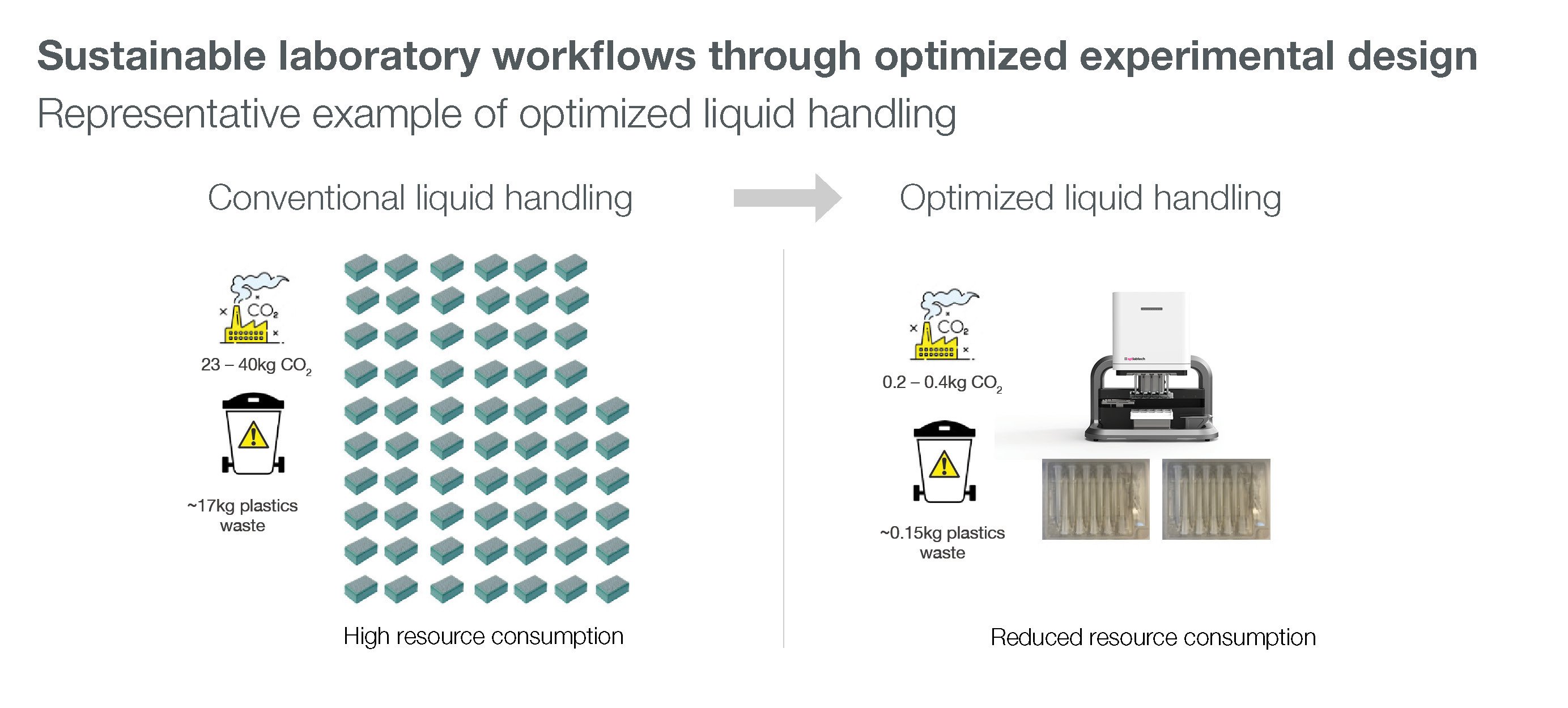
Application notes report reductions in resource use associated with these approaches, including decreased pipette tip usage compared with conventional pipetting workflows (up to 99.9%), reduced plastic consumables in NGS reagent dispensing workflows (up to 80%), and shorter liquid handling times (up to 98%) during automated assay preparation. Additional reductions in disposable tip usage (up to 96%) are described in enzymatic assay workflows. Reductions in optimization cycles have also been reported through the use of Design of Experiments (DoE), enabling more experimental conditions to be evaluated while reducing resource consumption.
-1-1.png?width=244&height=259&name=Mosquito%20HV_front%20perspective%20(no%20cover)-1-1.png) mosquito: miniaturized workflows and low-volume liquid handling
mosquito: miniaturized workflows and low-volume liquid handlingmosquito (SPT Labtech) utilizes positive displacement pipetting to enable miniaturized workflows at nanoliter scale. This approach allows reaction volumes to be reduced while maintaining precision and reproducibility, without compromising assay performance. Such workflows are particularly relevant in genomics, structural biology and low-input applications, where reagents may be limited or costly.
Reduced reaction volumes are associated with lower consumption of enzymes, master mixes and sequencing reagents, as well as decreased use of consumables such as tips and plates. Miniaturized workflows can also support increased throughput without a proportional increase in resource use and enable more efficient use of limited biological samples. Improved consistency in low-volume liquid handling contributes to reduced repeat experiments and improved reproducibility.
These principles have been demonstrated in automated transcriptomic workflows for ecotoxicity testing, where miniaturized high-throughput methods reduce reagent consumption, plastic waste and manual handling while enabling scalable analysis of environmental contaminants using human cell-based models.
Typical outcomes reported for miniaturized and automated liquid handling workflows include up to 99.9% fewer pipette tips and up to 96% fewer disposable tips during assay preparation, as well as up to 80% reductions in plastic consumables in NGS applications and up to 98% shorter liquid handling times during automated assay preparation.
These approaches also enable accurate dispensing at nanolitre scale (e.g. 200 nL), supporting assay miniaturization across a range of applications, including genomics, assay development, structural biology and cell-based research.
Laboratory sustainability is increasingly shaped by how experiments are designed and executed, rather than by downstream waste management alone. Approaches such as miniaturization, optimized experimental design and precise liquid handling demonstrate that reductions in reagent consumption, plastic use and experimental repetition can be achieved without compromising data quality or reproducibility.
These findings demonstrate that sustainability and experimental performance are not competing priorities, but can be addressed simultaneously through efficient experimental design and liquid handling strategies.
The examples discussed in this review highlight how liquid handling strategies can be applied across a range of laboratory workflows. Non-contact dispensing and positive displacement pipetting enable accurate low-volume liquid handling, supporting efficient use of reagents, consumables and biological samples. Application-focused examples illustrate how these approaches can reduce resource consumption and experimental variability while maintaining or increasing experimental throughput.
More broadly, these findings emphasize the importance of aligning experimental design with resource efficiency. By enabling multiple experimental conditions to be evaluated within a single workflow, reducing optimization cycles and improving consistency in liquid handling, these approaches support increased data generation from reduced material inputs.
As laboratory workflows continue to increase in complexity, integrating efficient experimental strategies will remain essential. Approaches that combine reproducibility, flexibility and reduced resource consumption are likely to play a key role in supporting more sustainable laboratory science.