
Automated Assay Development for Drug Discovery

Robust assay development for drug screening requires systematic optimization of multiple experimental variables. Automation enables researchers to efficiently design and execute complex multifactorial experiments while improving reproducibility, reducing variability, and accelerating workflow development.

13

Novel VPS4B inhibitors identified (BellBrook Labs + dragonfly discovery)

<5%

Error at 1 µL - dragonfly discovery (Artel verified)

<0.3 µL

Dead volume on mosquito - maximize precious compound recovery

1,536

Well format - develop assays in the HTS screening format from day one

OVERVIEW

What is Automated Assay Development?

What is Assay Development?

Automated assay development is the systematic, instrument-driven optimization of biological or biochemical assays for drug screening. It involves varying multiple parameters - reagent concentrations, incubation conditions, cell seeding densities, and detection settings - in a structured, reproducible manner to deliver a validated assay with sufficient signal-to-noise (Z' factor) for high-throughput screening. The critical insight is that assays should be developed in the same format they will be screened in - 384- or 1,536-well - to avoid re-optimization during format transfer. dragonfly discovery enables exactly this: developing assays directly in HTS format, with dedicated software for concentration gradients and optimization matrices, while mosquito handles the compound-side liquid handling that connects optimized assays to screening-ready compound plates.

SPT Labtech's dragonfly discovery and mosquito liquid handlers enable pharma and biotech scientists to precise, low-volume assay optimization at nanolitre volumes - reducing reagent costs, accelerating timelines, and improving data quality throughout the development process.

By automating complex liquid handling tasks, researchers can move more rapidly from assay concept to screening-ready protocol with confidence in the accuracy, consistency and reproducibility of every dispense. 

DRUG DISCOVERY PIPELINE

dragonfly discovery leads reagent dispensing. mosquito leads compound handling.

1
Target Selection
Biology
2
Assay Format Design
Gradient optimisation
dragonfly
3
Reagent Optimisation
Concentration matrices
dragonfly
4
Compound Addition
Assay-ready plates
mosquito
5
Dose-Response
IC₅₀ / EC₅₀
mosquito
6
Assay Validation
Z' & QC
dragonfly
7
HTS Campaign
Screening
FEATURED PLATFORMS

Two Instruments, One Complete Assay Development Workflow

dragonfly discovery owns the reagent side. mosquito owns the compound side. Together they deliver a seamless path from assay concept through to screening-ready method - with no format transfer penalty.
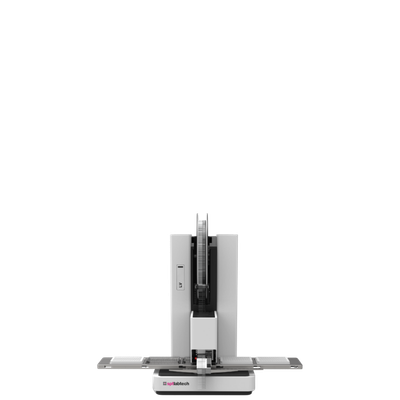
dragonfly discovery product card v2
dragonfly® discovery
Flexible Non-Contact Dispensing for DoE Workflows

dragonfly discovery enables accurate, repeatable non-contact dispensing from 200 nL to milliliter volumes across a broad range liquid classes and viscosities. Combined with intuitive software it provides an ideal platform for systematic assay optimization using Design of Experiments (DoE) approaches.

  • - Outstanding accuracy across full range of liquid classes with same instrument settings, including aqueous buffers, DMSO, detergents, and viscous reagents

  • - Non-contact positive displacement dispensing minimizes carryover risk and supports reproducible assay set up.

  • - Low dead volume reservoirs maximize value from precious reagents

  • - Intuitive software for ease of use, even for complex experimental setup

  • - Zero calibration or daily maintenance requirements

  • - Open-source CSV output loads directly into the dragonfly software package

  • - An open platform that can integrate with existing and future infrastructure for a walk-away operation.

Typical applications
application
Key Specifications
  • 200 nL – 4 mL
  • <5% error at 1 µL (Artel)
  • Non-contact dispensing
  • No calibration needed
  • 384- & 1,536-well
  • designer software included
  • API for robotic integration
Mosquito LV product card
mosquito®
Nanoliter Pipetting for Assay Miniaturization

mosquito delivers highly accurate, precise multichannel pipetting at volumes as low as 25 nL - enabling researchers to miniaturize assays into 384- and 1,536-well plate formats and make every microliter of precious compound count.

  • - Accurate transfer of low and high viscosity liquids, including 100% DMSO, without the need for liquid class creation or adjustments.

  • - Sample and assay integrity with low-cost disposable tips guarding against cross-contamination

  • - Serial and semi-direct dilutions for dose-response experiments, consuming as little as 0.5 µL of stock compound.

  • - Rapid plate reformatting across 96-, 384-, and 1,536-well plate formats.

  • - Miniaturization enables reduced chemical and single-use plastic waste associated with high-throughput experiments.

  • - An open platform that integrates with existing and future infrastructure for a walk-away operation.

Typical applications
application
Key Specifications
  • 25 nL – 5 µL
  • <0.3 µL dead volume
  • Zero carry-over (disposable micropipettes)
  • Viscosity-agnostic (DMSO)
  • 96/384/1,536-well
  • 1.5 min plate reformat
  • mosquito X1 for cherry-picking
REAL-WORLD EVIDENCE

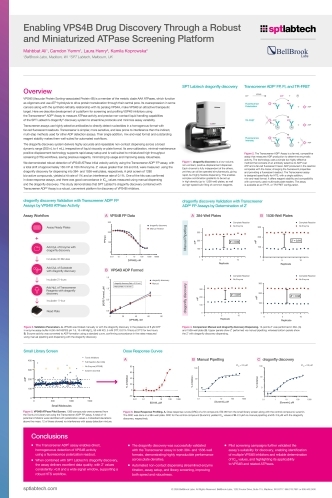
BellBrook Labs + dragonfly discovery: 13 Novel VPS4B Inhibitors

The most compelling proof of dragonfly discovery's assay development capability comes from a published cancer research collaboration that went from assay development through to novel inhibitor identification.

In February 2026, SPT Labtech and BellBrook Labs announced a miniaturized high-throughput screening platform combining BellBrook's Transcreener® ADP2 fluorescence polarization assay with SPT Labtech's dragonfly discovery for automated reagent dispensing. VPS4B has emerged as a high-priority therapeutic target in oncology due to its overexpression in specific tumours and its synthetic-lethal relationship with its paralog VPS4A - but the industry had lacked robust, scalable screening approaches to identify effective inhibitors.

The combined platform operated in both 384- and 1,536-well formats, improving data quality over manual approaches while significantly minimizing reagent consumption and cost. High-throughput screening on this platform identified 13 novel VPS4B ATPase inhibitors, which were then further evaluated using SPT Labtech's mosquito for rapid, robust follow-up testing. Data demonstrating the identification was presented at SLAS 2026.

This collaboration demonstrates the natural workflow: dragonfly discovery develops and dispenses the assay → mosquito handles compound follow-up → both operating in the same miniaturized HTS format.

13
Novel VPS4B inhibitors identified via dragonfly discovery screening
384 + 1,536
Well formats - assay developed and screened in the same format
<5%
Error at 1 µL - dragonfly discovery accuracy (Artel multichannel verified)
<0.3 µL
Dead volume on mosquito - maximize recovery from precious compound stocks
KEY CHALLENGES

Why Assay Development is a Bottleneck in Drug Discovery

The fast pace of modern drug discovery means laboratories are managing increasingly complex experiments at ever-growing scale. Assay development - the process of identifying and optimizing the right conditions for a robust screening assay - is one of the most resource-intensive stages in the early discovery pipeline.
Too many variables, too little time

Effective assay development requires the simultaneous optimization of multiple experimental parameters: reagent concentrations, incubation times, buffer composition, compound dilutions, and plate formats.

Traditional One-Factor-At-a-Time (OFAT) approaches are slow, reagent-intensive, and frequently fail to identify critical interactions between variables – limiting both efficiency and assay robustness.

Manual liquid handling introduces risk

Manual low-volume pipetting is inherently error-prone, particularly when working across a range of liquid classes and viscosities. Operator-to-operator variability, inconsistent plate fill timing and sensitivity to environmental conditions such as humidity and temperature can all compromise assay quality and data reproducibility. In many cases this experimental variability only becomes apparent much later in the screening workflow.

Precious reagents are consumed rapidly

 Early-stage drug discovery frequently rely on scarce, novel, or expensive compounds and biological reagents. Running optimization experiments at conventional microliter volumes can quickly consume valuable material, increasing both program cost and development risk.

The pressure to move faster

Pharma and biotech R&D timelines are under constant pressure to shorten development timelines and move rapidly towards screening. Technologies that compress the assay development cycle while maintaining assay quality, reproducibility and robustness are critical to successful drug development workflows.

Compound cross-contamination risk

Test compounds must be transferred between plates with absolute zero carry-over — a single contaminant at nanoliter scale can generate a false positive. mosquito uses disposable micropipettes for every transfer, providing guaranteed zero cross-contamination between compound samples. This is fundamentally different from the non-contact dispensing that dragonfly uses for reagents, where cross-contamination between reagents is not a concern.

Walk-up accessibility for multi-user labs

Assay development labs serve multiple project teams. Both dragonfly discovery and mosquito are designed for walk-up use - no daily calibration, no complex programming, intuitive software interfaces. dragonfly discovery requires three simple steps (select protocol, fit syringes, click run) and mosquito's protocol setup takes minutes, making both instruments accessible to any team member.

WORKFLOW AUTOMATION

How dragonfly discovery & mosquito Map to Each Assay Development Step

Each stage of an automated assay development workflow mapped to the specific SPT Labtech instrument best suited to that task.

Workflow Stage Task SPT Labtech Product Key Capability
Reagent Dispensing Detection reagents, substrates, enzymes, buffers across all wells of 96-, 384-, or 1,536-well plates


Non-contact positive displacement; 200 nL–4 mL; <5% error at 1 µL; handles all liquid classes including DMSO and basal membrane extracts
Concentration Gradients Defining and dispensing linear and n-fold reagent concentration matrices for assay optimization

dragonfly designer software: intuitive gradient definition, replicate layout, automatic volume calculation, CSV export
Cell Seeding Dispensing cell suspensions at defined densities for cell-based assay development   Non-contact dispensing preserves cell viability; consistent seeding density across all wells; compatible with viscous media
Compound Addition Adding test compounds at defined concentrations from DMSO compound stocks   25 nL–5 µL positive displacement; disposable micropipettes guarantee zero carry-over; DMSO-compatible; <0.3 µL dead volume
Serial Dilutions Generating dose-response dilution series for IC₅₀/EC₅₀ determination


Accurate, viscosity-agnostic serial dilutions from concentrated DMSO stocks; consistent volumes across all dilution points
Assay-Ready Plate Prep Reformatting compound plates from 96-well library stocks to 384- or 1,536-well assay plates   96→384→1,536 reformatting in under 1.5 minutes; direct mother-to-daughter plate replication; integrated seal piercing
Hit Cherry-Picking Selecting and reformatting confirmed hits for follow-up profiling and SAR studies Single-channel programmable access to any well across multiple deck positions; 25 nL–5 µL
General Plate Prep Standard curve preparation, sample reformatting, plate replication   Flexible multi-channel; interchangeable 96/384 core; accessible to every team member; no coding required
PURPOSE-BUILT SOFTWARE

dragonfly designer — Software Built for Assay Development Scientists

No other benchtop liquid handler includes dedicated software for assay development. dragonfly designer is complimentary with every dragonfly discovery instrument.

dragonfly designer is a complimentary software package developed specifically for assay development scientists. It provides intuitive definition of multiple concentration gradients - both linear and high dynamic range n-fold - definition of technical replicates and controls, automatic calculation of all well dispense volumes and overall reagent requirements, and open-source CSV file output that loads directly into the dragonfly software package for immediate execution.

The dragonfly software also includes a fully documented API for third-party integration with robotic plate handlers, stackers, and bulk liquid handlers - enabling walkaway operation in automated screening environments. This means dragonfly discovery can transition seamlessly from benchtop assay development through to integrated HTS operations without changing instrument or software.

Three simple steps to set up an experiment: select a protocol or design a new experiment in the intuitive software → fit positive displacement syringes and lay out reagents → click run. No calibration or daily maintenance required.

FREQUENTLY ASKED QUESTIONS

Automated Assay Development: Common Questions

Automated assay development is the use of liquid handling instrumentation and software to systematically optimize the experimental conditions required to produce a robust, reproducible assay suitable for drug discovery screening. It involves varying multiple parameters - such as reagent concentrations, volumes, incubation conditions, and plate formats - in a controlled and efficient manner, typically using statistical approaches such as Design of Experiments (DoE). Automation eliminates manual pipetting variability, accelerates the optimization cycle, and ensures results are reproducible across operators and runs.

Automated liquid handlers such as dragonfly discovery and mosquito use positive displacement technology to deliver precise, consistent volumes irrespective of liquid class or environmental conditions. Unlike manual pipetting or air-displacement systems, positive displacement technology is not affected by liquid viscosity, surface tension, or humidity. This eliminates operator-to-operator variability and tip-to-tip inconsistency - two of the most common sources of noise in manually prepared assays. The result is cleaner data and fewer repeat experiments.

Both dragonfly discovery and mosquito are compatible with standard SBS microplate formats, including 96-, 384-, and 1,536-well plates. mosquito supports rapid reformatting between all three formats, enabling straightforward miniaturization from standard 96-well development plates to high-density screening formats. dragonfly discovery's modular dispense head configuration can be customized to suit the throughput and plate format requirements of a given workflow.

Yes. Both dragonfly discovery and mosquito are built on true positive displacement technology, which delivers consistent dispensing performance regardless of liquid class. DMSO, aqueous buffers, detergents, glycerol, PCR master mixes, cell suspensions, and viscous basal membrane extracts are all handled reliably. This is particularly important in drug discovery assay development, where compound stocks are routinely prepared in DMSO and assay reagents span a wide range of viscosities.

dragonfly discovery and mosquito are complementary instruments designed to work together across the full liquid handling range required in assay development. mosquito uses disposable tip-based positive displacement pipetting to perform aspirate-dispense-mix operations, serial dilutions, and plate-to-plate transfers at volumes from 25 nL to 5 µL. dragonfly uses non-contact positive displacement dispensing from fixed syringes to bulk-dispense reagents from 200 nL to milliliter volumes into assay plates. In a typical assay development workflow, dragonfly handles reagent plate preparation and DoE matrix execution, while mosquito manages compound dilutions, cherry-picking, and sample transfers.

dragonfly discovery includes the dragonfly designer software - a dedicated tool for defining and executing DoE-driven assay optimization experiments. Scientists can specify multiple concentration gradients (both linear and high dynamic range n-fold), define technical replicates and controls, and automatically calculate well-level dispense volumes and total reagent requirements. The output is a CSV file that loads directly into the dragonfly instrument software for execution. This removes the need for manual calculation or programming and enables complex multifactorial assay development experiments to be set up and run rapidly, without specialist bioinformatics or robotics expertise.

Both dragonfly discovery and mosquito and feature a fully documented API for integration into automated laboratory workflows. dragonfly discovery features a fully documented API for third-party integration with robotic plate handlers, stackers, and bulk liquid handlers - enabling walk-away operation for high-throughput assay development campaigns. mosquito also integrates seamlessly with robotic plate handling systems. SPT Labtech's instruments are compatible with a wide range of laboratory automation platforms and scheduling software used in pharma and biotech R&D environments.

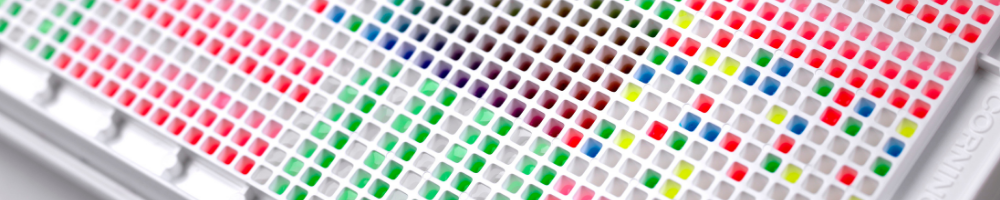
Direct‑to‑biology (D2B) in 1,536‑well formats can be implemented by combining miniaturized parallel synthesis with immediate assay readout in a single workflow. Reactions are set up at nanoliter scale across the plate, then diluted and transferred directly into compatible biological assays without purification.

References
  1. SPT Labtech (February 2026). BellBrook Labs HTS platform for cancer research. https://www.sptlabtech.com/news/spt-labtech-and-bellbrook-labs-introduce-high-throughput-screening-platform-for-cancer-research
  2. SPT Labtech. dragonfly discovery - unifying drug discovery. https://www.sptlabtech.com/resources/spt-labtech-dragonfly-discovery-unifying-drug-discovery
  3. Zhang JH, et al. Z’ factor for HTS assay evaluation. J Biomol Screen. 1999;4(2):67–73. https://doi.org/10.1177/108705719900400206
  4. Inglese J, et al. Quantitative high-throughput screening. Proc Natl Acad Sci. 2006;103(31):11473–8. https://doi.org/10.1073/pnas.0604348103

Ready to automate your assay development?

 Our drug discovery application scientists can demonstrate how dragonfly discovery and mosquito work together for your specific assay format, throughput, and screening workflow.