
Accelerating Medicinal Chemistry with Nanoliter-scale Automation

From exploring chemical and reaction space to supporting lead optimization, SPT Labtech’s liquid handling platforms enable high-throughput experimentation at the nanomolar scale - reducing material consumption, minimizing variability, and accelerating the design-make-test-analyze cycle.

1060

Drug-like molecules

100s-1000s

Compounds per program

6-12

Months per DMTA cycle

OVERVIEW

What is Medicinal Chemistry?

What is Medicinal Chemistry?

Medicinal chemistry is a multidisciplinary science at the intersection of chemistry, biology, and pharmacology, focused on the design, synthesis, and optimization of biologically active small molecules for therapeutic use. In early drug discovery, medicinal chemists design and synthesize compounds to interact with specific biological targets, such as enzymes or receptors. Compounds identified as “hits” are then refined during hit-to-lead and lead optimization, where systematic structural changes are made to improve properties such as potency, selectivity, and physicochemical and pharmacokinetic characteristics (often summarized as ADMET: absorption, distribution, metabolism, excretion, and toxicity).

To support these iterative workflows, high-throughput experimentation (HTE) is increasingly used to enable the parallel setup and evaluation of multiple reactions or conditions. Automation, particularly automated liquid handling, supports HTE by providing reproducible, miniaturized reaction setup and screening at scale, which is especially valuable when working with limited compound quantities or costly reagents.

DRUG DISCOVERY PIPELINE

Medicinal chemistry spans the early-stage synthesis and optimization phases highlighted below.

1
Target Identification
Biology & proteomics
2
Target Validation
Assay development
3
Hit Discovery
HTS & chemical space
4
Hit-to-Lead
Synthesis & SAR
5
Lead Optimization
ADMET & selectivity
Med Chem
6
Preclinical
In vivo studies
KEY CHALLENGES

Why Medicinal Chemistry Demands Automation

Manual approaches introduce variability and scale limitations that hamper both data quality and throughput. Automation directly addresses these core bottlenecks.
Constraints of manual workflows

Manual experimentation is inherently limited by user throughput and fixed plate formats, restricting experimental design and scalability. Critically, these constraints determine not just what can be tested, but what is never tested at all. Automation removes these limits, enabling flexible, higher-density experimental layouts.

Reproducibility across experiments

Small variations in pipetting volume, especially with viscous reagents such as metal catalysts or DMSO solutions, introduce variability that scales across datasets. Positive displacement nanoliter automation reduces operator-dependent error and eliminates this source of noise.

Scale of chemical space

The accessible drug-like chemical space is estimated at ~10⁶⁰ molecules. Navigating it efficiently requires combining AI/ML virtual screening with experimental validation at scale, placing increasing demand on automated HTE to generate reliable data.

Material scarcity and cost

Newly synthesized compounds and rare substrates are often available only in limited quantities. HTE at the nanomolar scale reduces material consumption by orders of magnitude, enabling comprehensive reaction screening from a fraction of the compound normally required.

DMTA cycle efficiency

The design-make-test-analyze (DMTA) cycle drives lead optimization. Parallel reaction setup and screening enable faster iteration, reducing cycle times from months to weeks, and shortening the path from hit to candidate.

Hazardous chemical handling

Organic solvents and metal catalysts present handling and safety challenges at manual scale. Miniaturized automation reduces the absolute volume of hazardous materials used per experiment, supporting greener chemistry practices and reducing waste generation.

APPLICATION DEEP DIVE

Chemical Space Exploration and High-Throughput Experimentation

Navigating chemical space with AI-driven HTE

Chemical space exploration is fundamental to drug discovery. With over 10⁶⁰ theoretically drug-like compounds, no experimental program can explore this space exhaustively. The most productive approach pairs AI and machine learning (ML) models for virtual screening with high-throughput experimentation (HTE) for experimental validation - creating a closed-loop optimisation cycle.

In this workflow, ML models prioritize candidate compounds from virtual libraries, and automated HTE validates them experimentally. The resulting data feed back into the model, progressively improving predictions and focusing further exploration on more promising regions of chemical space.

The performance of this loop depends on the quality of experimental data. Automated liquid handling eliminates the manual pipetting errors, volume inaccuracies, and plate-to-plate variability that introduce noise into HTE datasets - protecting the integrity of the models trained on them.

Ultra-high-throughput experimentation (uHTE)

Ultra-high-throughput experimentation (uHTE)

Ultra-HTE (uHTE) represents a step-change in experimental capacity, enabling simultaneous execution of thousands of discrete reactions at the nanomolar scale. This approach was demonstrated by Buitrago Santanilla et al. (Science, 2015), showing that nanomole-scale HTE could be successfully performed in 384- and 1,536-well formats using positive displacement liquid handling.

Key advantages of uHTE over conventional parallel synthesis:

  • >1500 reaction conditions screened in less than one day

  • Order-of-magnitude reduction in material consumption per experiment - as little as 0.02mg starting material and 1 µL needed

  • Compatibility with scarce or high-value compounds, including intermediates and catalysts

  • Reduced generation of hazardous chemical waste through miniaturization

1,500+
Parallel reactions at nanomolar scale
100x
More analogues, same material
>10 reaction classes
Miniaturized using SPT Labtech tools in peer-reviewed studies
<5% CV
Reproducible nanoliter pipetting, independent of liquid properties
Reaction types enabled by nanoscale automation

mosquito LV has been used in peer-reviewed research to miniaturize the following reaction classes:
WORKFLOW AUTOMATION

Which SPT Labtech Tool Supports Each Medicinal Chemistry Step?

Each stage of an automated medicinal chemistry workflow mapped to the specific SPT Labtech instrument best suited to that task.

Workflow Stage Task SPT Labtech Product Key Capability
Reaction setup Dispensing and mixing substrates, catalysts, and solvents in high density plate formats


Nanoliter-to-microliter positive displacement; viscosity-agnostic; compatible with DMSO and organic solvents
Cherry-picking Reformatting hits, selecting high-yielding reactions, normalizing concentrations Single-channel access to any well in any plate; 1 nL resolution; rapid transfer (~6 seconds per sample)
Biological Evaluation Setup of miniaturized assays and dose-response curves   Accurate low volume dispensing, reproducible dilution series in 384 and 1,536-well formats
Plate reformatting Sample reformatting and dilution, plate copy   Flexible pipetting 384-tip array to single column and row; no-pressure tip loading
Compound Storage Long-term management and retrieval of compound libraries from HTE campaigns   Scalable tube-based storage; automated retrieval; full audit trail
RECOMMENDED PRODUCTS

Automation Solutions for Medicinal Chemistry

SPT Labtech's instrument portfolio covers every stage of the medicinal chemistry automation workflow, from nanoscale synthesis to compound management.

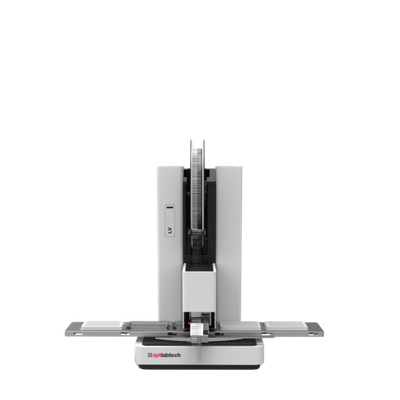
mosquito LV
mosquito®
Nanoscale multi-parallel synthesis & uHTE

The workhorse of medicinal chemistry automation. mosquito performs viscosity-agnostic positive displacement pipetting at volumes inaccessible to conventional liquid handlers, enabling true nanomole-scale high-throughput experimentation across diverse reaction types.

Typical applications
Multi-parallel synthesis Reaction discovery Condition optimization Direct-to-Biology Miniaturized assays
Key Specifications
  • Volume range: 25 nL – 1.2 µL (LV) or 500 nL - 5 µL (HV)
  • Viscosity-agnostic positive displacement technology
  • Multichannel head for high-density microplates (384 and 1,536-well)
  • Compatible with organic solvents & metal catalysts
  • Ultra-low source dead volumes
Explore mosquito
mosquito X1
mosquito® X1
Cherry-picking & compound normalization

A programmable single-channel instrument for flexible compound reformatting. mosquito X1 is ideally suited to cherry-picking validated hits from HTS plates for secondary profiling, or normalizing compound stock concentrations prior to dose-response assays.

Typical applications
HTS hit cherry-picking Compound normalization Secondary profiling Library reformatting
Key Specifications
  • LV mode: 25 nL – 1.2 µL per channel
  • HV mode: 500 nL – 5 µL per channel
  • Programmable access to any individual well
  • Multiple deck positions supported
  • Rapid single-channel throughput
Explore mosquito X1
SPT Labtech dragonfly
dragonfly® discovery
Reagent dispensing for reaction screening

dragonfly discovery delivers accurate, repeatable non-contact dispensing from nanoliters to milliliters across all standard microplate formats. Its independent dispensing channels are ideal for adding bases, solvents, or biological reagents to pre-plated compounds in HTE workflows.

Typical applications
Reagent addition Solvent dispensing Buffer preparation Assay development and setup
Key Specifications
  • Range: nanoliters to milliliters
  • No tip contact — minimizes cross-contamination
  • Up to 10 independent dispensing channels
  • Compatible with 96, 384 and 1,536-well formats
  • Accurate dispensing of viscous or volatile reagents
Explore dragonfly discovery
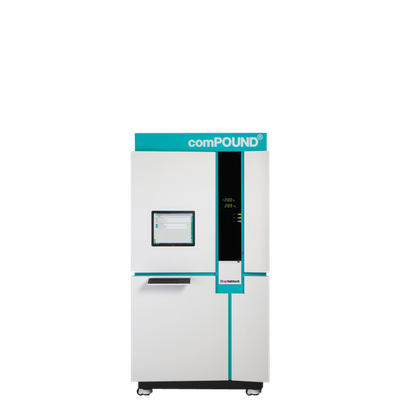
SPT Labtech comPOUND
comPOUND®
Compound management & storage

Compounds generated from HTE and uHTE campaigns need reliable, traceable storage and retrieval. comPOUND provides a scalable, secure automated compound management system that integrates directly with upstream synthesis and downstream screening workflows.

Typical applications
Compound library storage Automated retrieval Inventory management Compound integrity monitoring
Key Specifications
  • Scalable tube-based compound storage
  • Automated retrieval and reformatting
  • Full audit trail and inventory tracking
  • Supports integration with LIMS systems
  • Protects compound integrity over long-term storage
Explore comPOUND
FREQUENTLY ASKED QUESTIONS

Medicinal Chemistry Automation: Common Questions

Throughput in medicinal chemistry is often constrained by manual reaction setup, compound availability, and fixed plate formats. These limitations restrict how many conditions or analogues can be tested in a given cycle. Miniaturized, automated workflows help overcome these constraints by enabling parallel reaction setup, reducing material requirements, and increasing experimental coverage within each DMTA cycle.

High-throughput experimentation (HTE) refers to the automated, miniaturized parallel execution of large arrays of chemical reactions or assays. In medicinal chemistry, HTE is used for reaction screening, condition optimization, and compound evaluation. By running hundreds to thousands of reactions simultaneously in microplate format, HTE generates large, high-quality datasets that drive both human and machine-learning-guided decision making in the DMTA cycle.

HTE typically involves parallel experimentation in 24- or 96-well formats at the micromolar scale Ultra-high-throughput experimentation (uHTE) pushes this to 1,536-well plates and nanoliter reaction volumes, enabling thousands of experiments per run. The key advantages are dramatically lower material consumption per data point and the ability to work with scarce or expensive substrates and catalysts.

Conditions identified using HTE or uHTE are typically re-tested and optimized at larger scale. While not all reactions scale directly, miniaturized screening enables rapid identification of promising conditions that can then be validated under preparative conditions. This reduces the number of large-scale experiments, and associated time and resource requirements.

Machine learning models used in drug discovery rely on consistent, high-quality experimental data. Variability in manual workflows can introduce noise into datasets. Automated liquid handling improves consistency in reaction setup and assay preparation, supporting the generation of more reliable datasets for model training and iterative optimization.

Yes. mosquito instruments use positive displacement pipetting technology, which is inherently viscosity-agnostic and does not rely on air displacement (which fails with volatile or viscous liquids). This makes them suitable for DMSO-based compound stocks, organic solvents such as DMF, MeCN, and THF, and many catalyst solutions or suspensions.

A range of medicinal chemistry reactions have been successfully miniaturized using mosquito nanoliter liquid handler, including cross-coupling reactions, reductive aminations, nucleophilic substitutions, and photoredox transformations. The feasibility depends on reaction conditions, compatibility with small volumes, and mixing requirements, but published studies demonstrate broad applicability across reaction classes.

Direct‑to‑biology (D2B) in 1,536‑well formats can be implemented by combining miniaturized parallel synthesis with immediate assay readout in a single workflow. Reactions are set up at nanoliter scale across the plate, then diluted and transferred directly into compatible biological assays without purification.

References
  1. Buitrago Santanilla A, Regalado EL, Pereira T, et al. Organic chemistry. Nanomole-scale high-throughput chemistry for the synthesis of complex molecules. Science. 2015; 347 (6217): 49-53. https://doi.org/10.1126/science.1259203
  2. Lin S, Dikler S, Blincoe WD, et al. Mapping the dark space of chemical reactions with extended nanomole synthesis and MALDI-TOF MS. Science. 2018; 361 (6402): eaar6236. https://doi.org/10.1126/science.aar6236
  3. Pomberger, A, Pedrina McCarthy, A. A, Khan, A, et al. The Effect of Chemical Representation on Active Machine Learning Towards Closed-Loop Optimization. React. Chem. Eng. 2022, 7, 1368, https://doi.org/10.1039/D2RE00008C
  4. Gesmundo, N., Dykstra, K., Douthwaite, J.L. et al. Miniaturization of popular reactions from the medicinal chemists’ toolbox for ultrahigh-throughput experimentation. Nat. Synth 2. 2023, 1082–1091. https://doi.org/10.1038/s44160-023-00351-1
  5. Taylor CJ, Pomberger A, Felton KC, et al. A Brief Introduction to Chemical Reaction Optimization. Chem Rev. 2023; 123 (6): 3089-3126. https://doi.org/10.1021/acs.chemrev.2c00798
  6. Mahjour B, Zhang R, Shen Y, et al. Rapid planning and analysis of high-throughput experiment arrays for reaction discovery. Nat Commun. 2023; 14 (1): 3924. https://doi.org/10.1038/s41467-023-39531-0
  7. Stevens R, Bendito-Moll E, Battersby DJ, et al. Integrated Direct-to-Biology Platform for the Nanoscale Synthesis and Biological Evaluation of PROTACs. J Med Chem. 2023;66(22):15437-15452. https://doi.org/10.1021/acs.jmedchem.3c01604

Ready to accelerate your medicinal chemistry workflows?

Our application scientists can help you identify the right automation strategy for your specific synthesis or screening challenge.