






Rethinking mRNA Workflows From Manual Processes to Automated Precision with EMBL and NEB
06/08/2026
Share this blog
06/08/2026


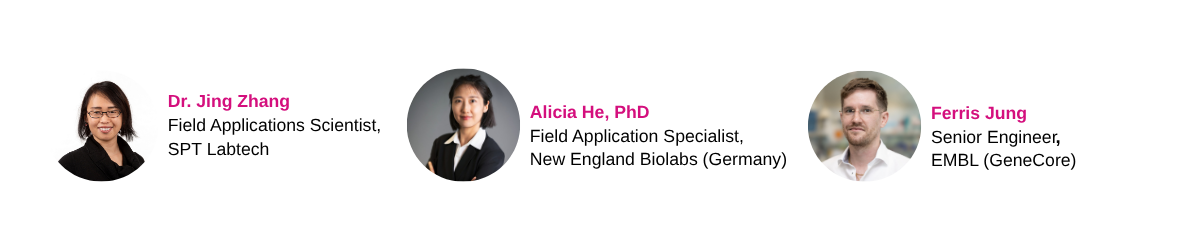
Automation & Miniaturization: Streamlining Next-Generation Sequencing (NGS) Workflows - Q&A with Ferris Jung (EMBL), Alicia He, PhD (NEB) and Dr. Jing Zhang (SPT Labtech).
Moving high-throughput sequencing from manual execution to automated precision requires careful balancing. Laboratory teams must navigate hardware specifications, optimize enzyme chemistry, and manage the physics of liquid handling, all while maintaining data complexity and minimizing sample loss.
In this comprehensive panel discussion, leading experts from the European Molecular Biology Laboratory (EMBL), New England Biolabs (NEB), and SPT Labtech discuss practical approaches to automating and miniaturizing both RNA and DNA library preparations.
Key Takeaway: Custom automation setup is handled via a three-way collaboration between the customer, NEB, and the liquid handler vendor, backed by physical reagents and on-site support.
Alicia He (NEB): At NEB, we take a collaborative, flexible approach to automation support. When implementing a new or customized workflow, we work directly alongside the customer and the liquid handler vendor. Our support model includes:
Open communication across all three parties to map out the script.
Reagent allocation from NEB specifically for automation testing and validation.
On-site application support to physically help translate a manual protocol into an automated script, minimizing risk during transition.
Dr. Jing Zhang (SPT Labtech): The firefly community currently has protocols enabled for the following total RNA and rRNA depletion workflows:
Ferris Jung (EMBL): We have begun testing NEB’s rRNA depletion workflow on firefly, and early results look promising. Because NEB’s method utilizes a straightforward probe hybridization followed by enzymatic digestion, it relies heavily on simple master mix additions, making it highly automation-friendly.
Regarding volume reduction, a 2x to 4x reduction is realistic on firefly, but a 10x reduction is likely too extreme due to the physical limits of recovering and transferring very low elution volumes during bead clean-ups.
Key Takeaway: Check pre-sequencing metrics (yield, adapter dimers, insert size) to spot batch effects early, but evaluate sequencing metrics (duplication rate, coverage uniformity) for true quality confirmation.
Dr. Jing Zhang (SPT Labtech): In general, we look at yield, insert length, and adapter dimer percentages relative to manual controls. For target enrichment applications, we also add sequencing-based target coverage checks.
Ferris Jung (EMBL): The primary variance occurs when comparing a manual batch directly against an automated batch (inter-batch effects). Variations between automated runs are typically minimal. Your first line of defense should be using tools like FastQC right after the run to inspect adapter contamination and insert size distribution.
Alicia He (NEB): Beyond library yield, you must look downstream at post-sequencing metrics. Specifically evaluate duplication rates, transcript coverage uniformity, and library complexity to fully confirm automated library quality.
Ferris Jung (EMBL): The primary bottleneck is the heavy reliance on mid-process QC checkpoints. Unlike short-read workflows, long-read protocols often require you to pause, quantify or check size distribution, and adjust inputs before moving to the next enzymatic step. These constant interruptions make a completely hands-off "walk-away" protocol incredibly complex and expensive to engineer.
Alicia He (NEB): Sample handling constraints are another major issue, particularly for Oxford Nanopore Technologies (ONT). ONT protocols frequently process samples in parallel and then pool them for the second half of the workflow. For a 96-well plate, an equi-volume pool creates a single large liquid volume that is very difficult for a compact instrument like the firefly to handle.
Potential Workaround: We are exploring splitting 96 samples into smaller sub-pools (e.g., 4x 24-sample pools), though this scripting is still in early development stages.
Key Takeaway: Pooling libraries before performing a single, targeted SPRI bead clean-up is much more efficient than cleaning 96 individual wells, but extreme contamination may require gel-based size selection.
[Dimers Detected in Trace]
│
Is contamination severe?
├── No ──> Pool samples ──> Apply 0.8x - 0.9x SPRI Clean-up
│
└── Yes ─> Gel-based / Pippin Prep Selection (Expect ~50% sample loss)
Ferris Jung (EMBL): Cleaning up 96 individual wells is highly inefficient. Instead, we quantify individual libraries (via Qubit and TapeStation/Bioanalyzer), calculate molarity based on average size, and pool them. We then perform a single post-pooling clean-up using standard or slightly tighter SPRI bead ratios.
Caution: Instruments like the TapeStation can occasionally underestimate adapter dimer peaks. If you see even minor dimer indications on a trace, assume they will compete during sequencing and plan a post-pool clean-up.
Alicia He (NEB): Because adapter dimers outcompete genomic fragments during cluster generation, Illumina recommends keeping contamination below 0.5%.
If dimers are visible on a trace, a 0.8x or 0.9x SPRI bead clean-up is usually sufficient.
In worst-case scenarios where contamination is substantial, you may have to resort to gel-based size selection or automated platforms like Pippin Prep. However, be aware of the trade-off: physical size selection typically incurs a ~50% loss in library recovery.
Alicia He (NEB): It depends on the vendor. In most cases, scripts are proprietary and distributed directly through the liquid handler hardware vendors, which may require a purchase. However, NEB will always provide technical and application support to help you implement and validate those scripts on-site.
System Note: For users on the firefly® platform, all validated methods hosted in the firefly community cloud are accessible to users completely free of charge.
Dr. Jing Zhang (SPT Labtech): From a hardware standpoint, high-precision liquid handling easily manages volume scaling, provided it falls within the physical specs of the instrument. However, a 10x reduction requires careful optimization. Currently, a 5x miniaturization scale is widely proven and running successfully at various customer sites using NEB and Illumina kits.
Alicia He (NEB): A true 10x reduction is physically achievable, and peer-reviewed data demonstrates that biological signals are well preserved:
Technical Warning: 10x miniaturization pushes the minimum dispense and elution limits of automated pipetting. It requires precise local validation to guarantee long-term run-to-run reproducibility.
Validated Kits for Bacterial Miniaturization
Bacterial scaling has been successfully performed on:
NEBNext® Ultra™ II Directional RNA Library Prep (paired with rRNA Depletion Kit v2)
Illumina® Stranded Total RNA Prep (paired with Ribo-Zero Plus or Ribo-Zero Plus Microbiome)
The Elution Bottleneck
While a 2x to 4x reduction is highly stable, going lower introduces the "bead clean-up bottleneck." To elute bound nucleic acids in a 10x reduced workflow, you must use incredibly small liquid volumes 5 μL to 7 μL, which standard magnetic plates cannot handle cleanly.
Proven Technical Solutions
Specialized Hardware: Incorporating a specialized low-elution magnet (such as an Alpaqua magnet) has successfully enabled reproducible 5 μL elutions on the firefly platform.
On-Bead Processing: Bypassing intermediate elution steps entirely by keeping the synthesized second-strand cDNA immobilized on the beads throughout early cleanup rounds.
DNA vs. RNA Complexity: DNA library prep (like UltraExpress DNA) is inherently easier to miniaturize than RNA prep. DNA workflows don't require solid-phase bead steps until the final library clean-up, which can safely be performed in a standard, comfortable volume.